
Flavor Metabolic Profile Changes and Key Contributing Compounds in White Teas Aged Over 10 Years
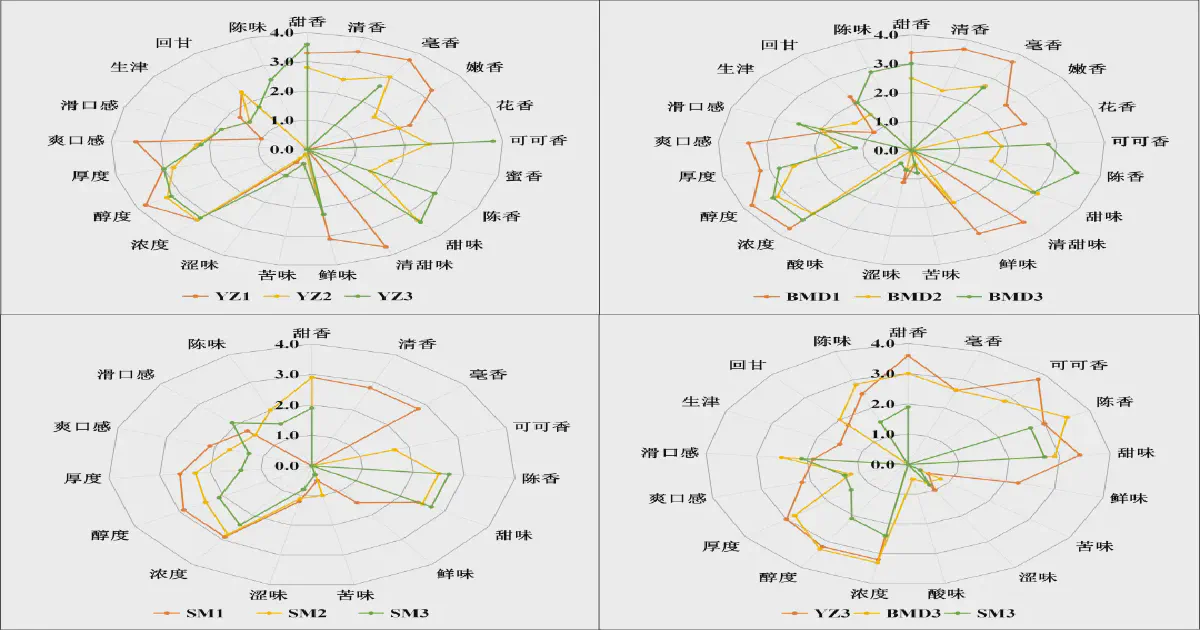
Comparative Analysis of Sensory Flavor Changes in Aged White Teas
With increasing popularity of white tea—often described as ‘one-year tea, three-year medicine, seven-year treasure’—scientific understanding of how storage influences sensory quality remains incomplete, particularly regarding key compounds driving these changes.
This study systematically investigates sensory quality evolution and associated chemical contributors across three age groups: white teas stored for less than 3 years, 3–9 years, and over 10 years. Samples include Baihao Yinzhen (BHYZ), Baimudan (BMD), and Shoumei (SM), all stored under stable, standardized conditions.
As storage duration increases: (i) In aroma, fresh and downy notes gradually diminish; tender and floral notes weaken notably in BHYZ and BMD; concurrently, aged aroma intensifies, accompanied by emergence of secondary notes such as cocoa and honey aromas. (ii) In taste, initial clean sweetness transforms into pronounced sweetness; umami, briskness, intensity, mellow character, thickness, and downy flavor scores all decline, whereas aged flavor and smooth mouthfeel progressively accumulate. White teas aged over 10 years exhibit strong sweet and aged aromas, prominent cocoa aroma, intense sweet and aged taste, and low bitterness and astringency.
Correlation Analysis Between Non-Volatile Compounds and Taste Sensations
Theanine—the most abundant amino acid in tea—shows the strongest and broadest positive correlations with taste attributes: clean sweetness, downy flavor, briskness, umami, intensity, thickness, mellowness, and after-sweetness (all p 10 years’ storage, their proportions decline to 25.37%, 23.55%, and 16.20%, respectively. Overall, aging consistently reduces aldehydes, alcohols, and ketones while increasing esters and acids across all white tea types.
Correlation Analysis Between Key Volatile Compounds and Aroma Sensations
Sensory aroma profiling clusters white tea aromas into two major groups: Group I comprises fresh, tender, and floral notes (e.g., clean aroma, tender aroma, floral aroma); Group II comprises cocoa and aged aromas.
In Group I, linalool exhibits the most dramatic decline: its relative abundance drops from 8.08–10.42% in fresh samples to only 3.30–5.13% in teas aged >10 years. Geraniol decreases markedly in BHYZ. β-Ionone declines across all samples but remains relatively stable in SM. Collectively, reductions in alcohols, aldehydes, and ketones—compounds imparting fresh and floral notes—are the primary drivers behind diminishing freshness during storage.
In Group II, among acids, lauric acid, octanoic acid, geranic acid, acetic acid, benzoic acid, and heptanoic acid all increase with storage duration within each cultivar. Except for valeric acid, all show significant positive correlations with aged aroma. Among esters, all except phenethyl acetate and methyl phenylacetate correlate significantly and positively with cocoa aroma.
This article is excerpted from China Tea, 2026, No. 3, pp. 78–88: ‘Flavor Metabolic Profile Changes and Key Contributing Compounds in White Teas Aged Over 10 Years’, by Yu Qiuwen, Lin Xiaohong, Liu Xiangzhen, Zhang Jun, Zou Xinwu, Du Yingying*.
Source: 《China Tea》(中国茶叶) 2026, Issue 3, pp.78-88. “Research on Flavor Metabolic Profile Changes and Key Contributing Compounds in White Teas Stored for Over 10 Years.” Authors: Yu Qiuwen, Lin Xiaohong, Liu Xiangzhen, Zhang Jun, Zou Xinwu, Du Yingying.